

Hello! Yes, it’s been nearly two years since I wrote an entry here, but it feels good to be back in your inbox—back like I never left—and I hope to keep carving out time when possible to say something through this newsletter.
I started this thing in 2020, and this is Issue 30. The World Cup is in town, and I want to talk about a soccer novel (football, in the proper global parlance) that is as much about work and the workplace as it is about soccer.
But first: what have I been reading? I won’t recount everything from the past two years, but in the past six months I’ve read and loved: The Director by Daniel Kehlmann (I’ve read all his books and would put this one second after Tyll); Glorious Exploits by Ferdia Lennon (so fun and original, especially as a lover of classics, I immediately wanted to re-read it); King Sorrow by Joe Hill (I’ve also read Horns); The Road to Tender Hearts by Annie Hartnett; The Rest of Our Lives by Ben Markovits (loved the voice, really surprised me in the end); The Guide by Peter Heller (have also read and loved The Painter and Celine); Suder by Percival Everett (his first novel from 1983 recently reissued, my least favorite of his, but he’s always fun and madcap); Playworld by my friend Adam Ross (we met after I reviewed his novel Mr. Peanut on my old blog in 2011); The Association of Small Bombs by Karan Mahajan; and Olga Dies Dreaming by Xochitl Gonzalez. And I read and just liked: Bonsai by Alejandro Zambra (discovered at a bookstore in Puerto Rico); The Man Who Died Seven Times by Yasuhiko Nishizawa; You Dreamed of Empires by Alvaro Enrigue; Success by Martin Amis (my sixth of his); and We Used to Live Here by Marcus Kliewer. And I read and did not like: Among Friends by Hal Ebbott; and Vigil by George Saunders (very disappointing! felt didactic and patronizing, Dwight Garner nailed it).
Now: to the football pitch.
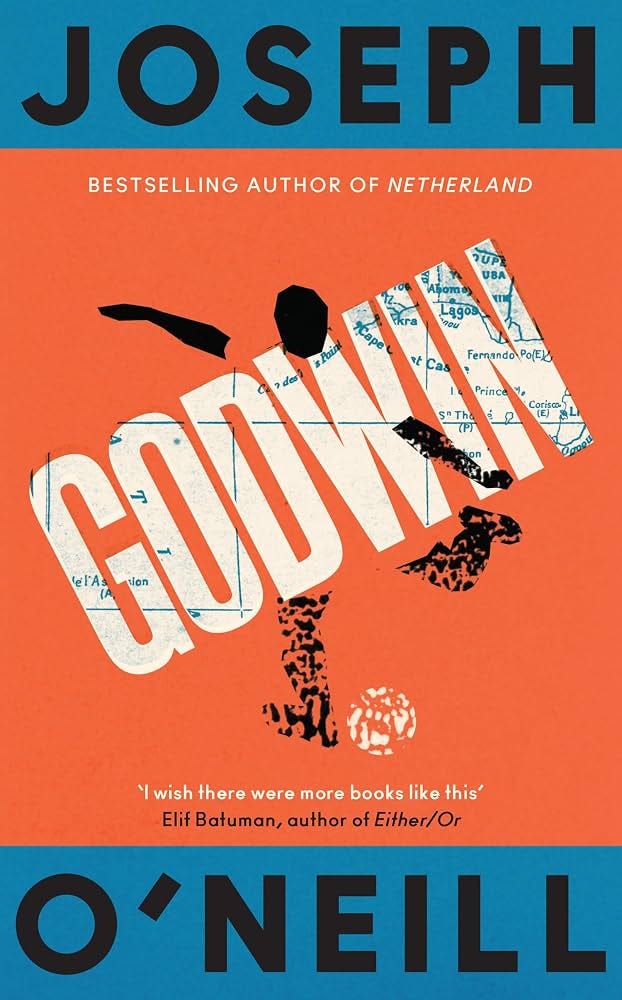
Joseph O’Neill got very famous in 2008 for his hit novel Netherland, which is ostensibly about cricket but is really about New York City post-9/11 and national identity.
Godwin is ostensibly about football (i.e. soccer) but is really about office politics, client relations, and email etiquette.
And I should disclose: I didn’t love Godwin. Why then, you might ask, am I wasting digital ink writing about in great detail? Because it has stuck with me, despite being dense and sometimes slow. And amid World Cup fervor, I’ve thought about it a lot.
The Guardian, insanely (in my view), titled its review of the novel “unmissable edge-of-your-seat drama,” and Godwin is almost never that—it is in fact a process novel that reminds me more of Tom McCarthy’s The Making of Incarnation.
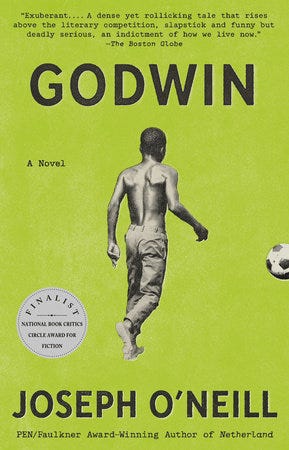
The novel alternates narrators between Mark Wolfe, a technical writer in Pittsburgh whose half brother Geoff is a wannabe soccer agent in the U.K. and is desperate to find the African soccer phenom shown in a viral video, and Lakesha Williams, who works with Mark and is fending off an attempted organizational coup at their writer collective.
Wolfe is the de facto protagonist, but it’s Lakesha who opens and closes the novel, and it’s Lakesha’s workplace saga that, somehow, feels more real and more urgent than Mark’s soccer phenom hunt playing out in parallel.
Some of Lakesha’s private observations about work are accidentally profound. Working alone in the office at night, she says, “There always came a moment when the quiet would get to me, and I’d become conscious of the melancholy of a deserted office… There was a sense, at such moments, that I was imperceptibly working alongside the women in bonnets and ankle-length dresses who had once operated crimping machines in this very space. It was not my favorite feeling. It usually led to another uneasy thought: that everything we had worked foe at the Group was impermanent, that everything hung by a thread that could not be seen.”
Where Lakesha is earnest and stone-serious about work, Mark is cynical and acidic, and I underlined in my copy of Godwin a great deal of his observations, especially about working with much younger people: “With that mild psychopathy of youth, they can’t help viewing the world, and the people in it, as a kind of ironic, semifictional entertainment; and it may even be that in their bones they sense the presence of a discriminating god alert to their secret virtues.”
Mark is forced to take some time off from the Group after he’s an asshole to someone, but his incisive commentary on How We Work Now, and the sensitivities now required in work communications, made me nod my head in agreement and recognition: “For a long time, I’d resisted the culture of digital correspondence in which it was one’s job not only to convey relevant information but also to fake affection and friendship… I hadn’t grasped that a message that would formerly have been understood as concise and helpfully businesslike might now be interpreted as curt and unkind, or that the polite and appropriate ‘Dear’ greeting in place of the infantile ‘Hi’ might be received as cold and dominating. This was an absurd development, but whatever. I adapted.”
And then the introduction of Geoff and his quest. Mark’s half brother in England convinces Mark to fly over to help him with a vague but supposedly lucrative business opportunity. (He promises to repay all of Mark’s expenses, which Mark knows will never happen; his brother is a repeat failure and liar.) Once Mark arrives, Geoff shows him a series of video files of a soccer prodigy performing feats of magic on the pitch—even Mark, not a soccer expert, can recognize the skill:
“What Geoff shows me is perceptually alien. To put it very basically, the kid scores two solo goals that involve what seem to be fictive spatial and technical powers — an aptitude for drifting at high speed into a pack of opponents and emerging with the ball at his feet and his would-be tacklers decisively, tragicomically sprawled behind him. There is something distinctly asynchronous about the spectacle, and this quality is only heightened by the fact that it’s a silent movie. We’re offered the illusion that a hidden dimension of human movement, of the relation between gravity and physiology, is being revealed. I’m looking at something that is simultaneously familiar and beyond recognition.”
Geoff doesn’t know where the video is from or if Godwin is even the kid’s real name. He already paid an intermediary $5,000 just for access to the video for three months, and the three months is almost over. “I’m not saying he’s as good as Messi. I’d never say that. But he’s like him,” Geoff tells Mark, clearly working him (like… a mark). “You’re the cleverest person I know, fam. If you can’t find him, no one can.” The pitch works, and Mark becomes nearly as invested in finding the kid as Geoff.
That all sounds like a pretty thrilling setup for adventure, but what actually happens is a series of missed connections, fumbles, and side quests—which still might sound exciting, but many of these scenes drag. That’s by design, in an apparent effort to convey how tedious and futile the business of football representation can be, where stars have no loyalties and agents happily betray other agents to steal a client.
In this way, the soccer scouting plot is as much a statement on the tedium of work as the office drama playing out at the Group.
Geoff had his own football dreams, and now he’s a jaded former player attempting to make money representing players while also railing against all the other guys doinf the same. “Footballers in the lower leagues, the kind Geoff has represented, players who made a grand or two a week, always feel like they’re just a twist of fortune away from the big time, especially the younger ones. They believe that their true ability is camouflaged by the mediocrity of the players around them and that their qualities will be recognized with the right management, the right exposure. Once upon a time, Geoff used to be one of these players. He believed himself to be one scouting report away from fame and riches.”
Geoff is a maddening presence for Mark and for the reader—dishonest, flighty, cheap, unreliable (almost every character in the book is unreliable). But the series of betrayals Mark suffers by getting himself in too deep is portrayed as par for the course in the football business. There’s no honor among thieves, and Geoff is no better than any of the other rats he’s racing to find Godwin. As the French talent scout Lefebvre tells Mark at one point, “This was very stupid — the idea of his integrity. Your integrity, your high standards, your sacrifices, your renunciations — these are noticed only by yourself. Nobody else is keeping track. There was not one person in the world who was giving him credit for his negative decisions. Only the positive was visible, and then only briefly.”
While the effort to find Godwin is of monumental importance for Geoff, it’s more like a flight of fancy for Mark; he can get off the ride at any time. The organizational unrest playing out at the Group in Pittsburgh, meanwhile, is something so petty but also so legitimately important to the people involved—it’s their livelihood—that it has more weight than the Godwin goose chase.
And yet, by its nature, the football plot carries a grandeur and globality that the micro-plot in Pittsburgh can never have. Football is big business, as Geoff explains to Mark (and as everyone watching the current massively popular World Cup knows):
“The jackpots are real. The TV rights to English football are global and massive. Every year, the twenty Premiership clubs split between them a pot worth three billion dollars. ‘Billion, blud.’ And that’s before gate receipts, shirt sponsorships, merchandising income, profits on player sales. On top of all that, European clubs are now owned by very, very rich entities: sovereign wealth funds, American hedge funds, Russian oligarchs, Arab royals. And the product — English football — is more popular, more global than ever.”
Given that pitch, how could Mark not fall for the lure of the quest? Many steps (and flights) later, including two solid plot twists (one involving the shadowy mother Mark and Geoff share), we at least get a definitive answer and result to the Godwin search (Google Earth again plays a part, as it did in Netherland), but it’s hard to argue it was worth it. And all of it reiterates that in football scouting, it’s impossible to know whether a hyped prodigy will end up with a career like Lionel Messi or more like Freddy Adu.
O’Neill draws an excellent parallel to the workplace drama, once the two plots finally converge, showing how the villains in both go mostly unpunished and the ‘good’ actors are left unrewarded for living according to their honor code.
If all of that sounds like fun, read Godwin and let me know what you think. And if you want some other brainy sports novels, some of my favorites are: The Art of Fielding by Chad Harbach (high school baseball); The Cactus League by Emily Nemes (minor league baseball); The Universal Baseball Association, J. Henry Waugh, Prop. by Robert Coover (fantasy baseball); or End Zone by Don DeLillo (high school football). And if you want other workplace fiction, read: The Pale King by David Foster Wallace; Then We Came to the End by Joshua Ferris; Personal Days by Ed Park; My Search for Warren Harding by Robert Plunket; or Microserfs by Doug Coupland.
--
If you enjoyed this issue, please forward to a book-loving friend and tell them to subscribe. See you next time; I hope it won’t be another two years until then.